
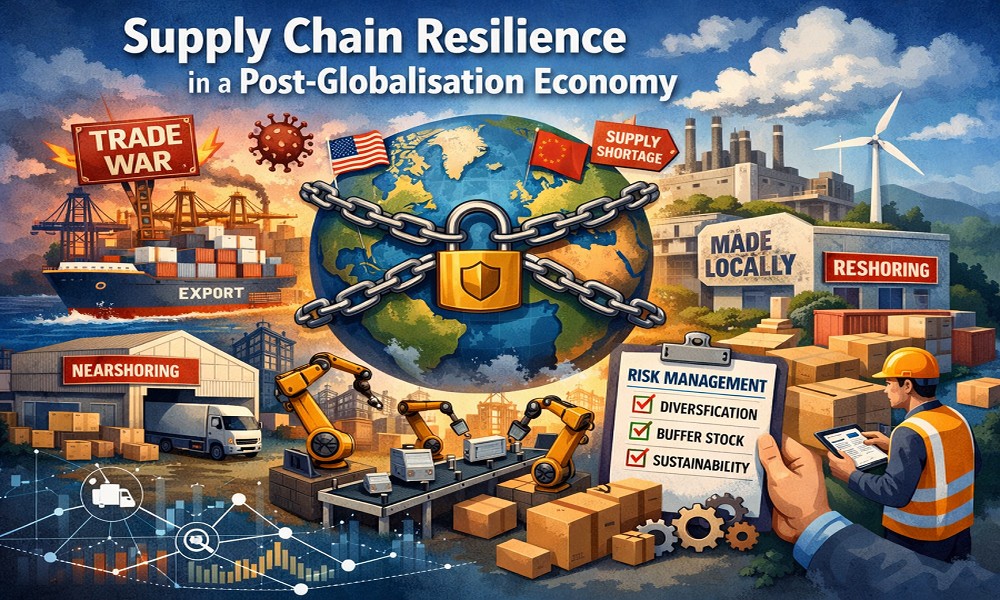

For decades, globalisation drove supply chain strategy. Businesses prioritised cost efficiency, lean inventory models and international sourcing networks that spanned continents. However, recent disruptions – from pandemics and geopolitical tensions to shipping bottlenecks and energy shocks – have exposed vulnerabilities within these highly optimised systems. As a result, supply chain resilience has become a central economic concern, influencing corporate strategy, inflation dynamics and national policy. Economic commentators and analysts such as Kavan Choksi have observed that the focus is shifting from pure efficiency toward stability and adaptability in an increasingly uncertain global environment.
The traditional just-in-time model aimed to reduce inventory costs by synchronising production closely with demand. While effective under stable conditions, this approach left little room for unexpected interruptions. When factories shut down or transportation networks stalled, shortages quickly emerged. Businesses and policymakers alike began reassessing whether minimal inventory and single-source suppliers were worth the associated risk.
Resilience now often involves diversification. Companies are seeking multiple suppliers across different regions to reduce dependency on any single country or transport route. This strategy may increase costs in the short term, but it provides a buffer against localised disruptions. In some cases, firms are exploring nearshoring or reshoring – relocating production closer to end markets. While labour and operational expenses may be higher, shorter supply chains can improve responsiveness and reduce exposure to geopolitical risk.
Technology plays an increasingly important role in strengthening supply networks. Digital tracking systems, real-time data analytics and predictive modelling enable businesses to anticipate potential bottlenecks before they escalate. Enhanced visibility across supply chains allows companies to respond more quickly to fluctuations in demand or supply constraints. Investment in automation and robotics can also mitigate labour shortages and improve operational continuity.
From a macroeconomic perspective, the push for resilience may have inflationary implications. Diversified sourcing and higher inventory levels can raise production costs. Consumers may ultimately bear some of these increases through higher prices. However, the trade-off lies in reducing the frequency and severity of disruptive shortages that can cause even sharper price spikes. Policymakers must balance these factors, considering both economic competitiveness and national security concerns.
Governments are also intervening more directly in strategic sectors. Incentives for domestic semiconductor production, renewable energy components and critical medical supplies reflect a broader recognition that certain industries require greater domestic capacity. This shift marks a departure from the previous era of deep global integration, signalling a more cautious approach to international dependency.
Ultimately, supply chain resilience in a post-globalisation economy is about recalibrating priorities. While cost efficiency remains important, stability, transparency and adaptability have become equally vital. Businesses that integrate diversified sourcing, technological innovation and strategic risk management into their supply frameworks are better positioned to withstand shocks. In a world where uncertainty has become a defining feature, resilience is emerging as a competitive advantage rather than a secondary consideration.