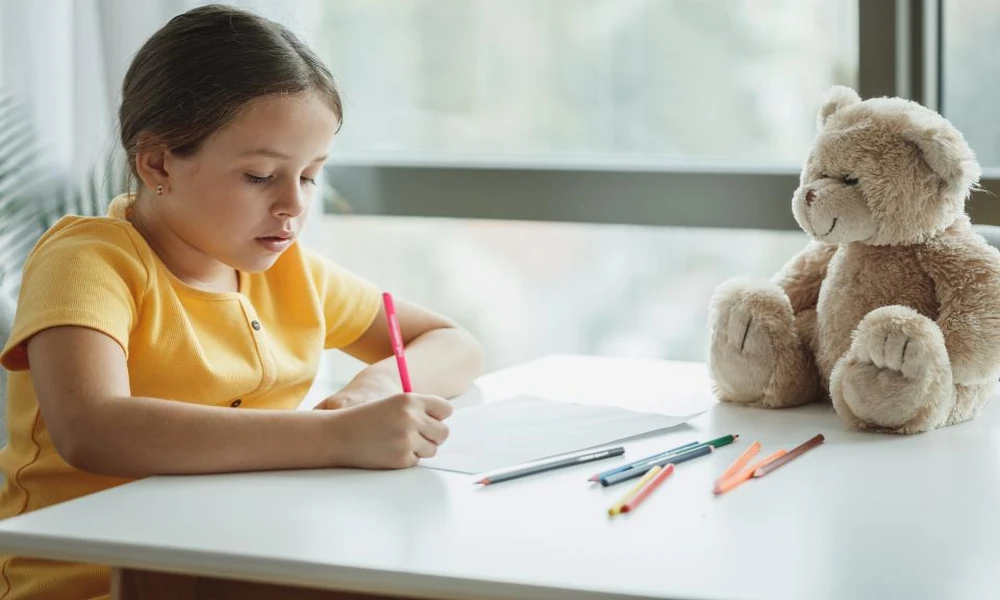

Photo: “Child Homework” by Direct Media, via StockSnap, public domain (CC0).
Parents at private schools in the US and UK often hear that their children are “doing Spanish.” They see songs at the school concert and vocabulary sheets in book bags. What they rarely see is clear evidence of what their child can actually do in the language, and how that compares with what’s expected at their age.
For schools, measuring progress is just as important. Without it, it’s hard to know whether a programme is working, whether the time given to Spanish is enough, or whether students are ready for the next stage. Good assessment comes down to knowing what children should be able to do and checking regularly whether they can, which rarely requires formal tests.
Start with what children should be able to do
The most useful way to describe progress in a language is in terms of what learners can do with it, rather than which units they’ve covered. Can a child greet someone and introduce themselves? Ask and answer simple questions about their family? Understand a short story read aloud? Write a few sentences about their weekend?
Many US schools use ACTFL’s proficiency levels, from Novice through Intermediate to Advanced, to describe these stages. In the UK, prep schools often plan toward the expectations of senior school entry or the Common Entrance exam at 13.
Setting clear goals for each year group, written in plain “can do” terms, gives teachers, parents, and students a shared picture of success.
Assessments built for young learners
Several external assessments are designed for school-age learners, which helps schools benchmark their students against a wider standard.
In the US, one option is the AAPPL, the ACTFL Assessment of Performance toward Proficiency in Languages. According to Language Testing International, the AAPPL assesses standards-based learning across three modes of communication: interpersonal, presentational, and interpretive. It’s rated against the ACTFL Performance Descriptors for Language Learners, covers interpersonal listening and speaking, presentational writing, interpretive reading, and interpretive listening, and is available in Spanish. Its Form E, focused on interpersonal listening and speaking, is designed for grades 3 and 4.
Internationally, the Instituto Cervantes offers DELE certificates for schoolchildren, which are graded against the Common European Framework of Reference and recognised in the UK, the US, and beyond.
External assessments like these are useful at key points, such as the end of primary or elementary school, rather than every term.
Everyday assessment in the classroom
Most useful assessment happens in ordinary lessons. Good teachers check understanding constantly, through questions, quick games, and short tasks, and adjust what they teach in response.
A few simple methods work well with children. Short one-to-one conversations, a minute or two per child, show how well they understand and respond. Picture description tasks show vocabulary and the ability to build sentences. Listening tasks, where children follow instructions or match pictures to what they hear, show comprehension. And short pieces of writing, from labelled drawings to simple sentences, show developing literacy.
Recording a child speaking at the start and end of a year is especially powerful. Parents, teachers, and children can hear the difference.
Portfolios and self-assessment
Language portfolios collect evidence of progress over time: recordings, writing samples, projects, and teacher notes. Many schools add simple self-assessment checklists, where children colour in “I can” statements as they achieve them.
Self-assessment helps children understand their own progress and set goals. It also gives parents a clear, child-friendly picture of what’s been learned.
Reporting to parents
School reports often say little more than “enjoys Spanish and participates well.” Parents get far more from specific information: what their child can now do, examples of their work, the next goals, and how they can help at home.
Some schools share short recordings or portfolio highlights each term. These are popular with families and help show the value of the programme.
Using results to improve the programme
Assessment results help schools as well as families. If most children in a year group struggle with listening, teachers can build in more listening practice. If progress stalls in a particular year, the school can look at timetabling, staffing, or curriculum at that stage. If external assessments show students falling short of expectations, it may be a sign that weekly time for Spanish needs to increase.
Questions parents can ask
Parents who want to understand their child’s progress can ask a few questions. What should my child be able to do in Spanish by the end of this year? How is progress assessed, and how often? Does the school use any external assessments? Can I see or hear examples of my child’s Spanish? And what can we do at home to help?
A school that can answer clearly, with examples, is likely to be taking Spanish seriously.