
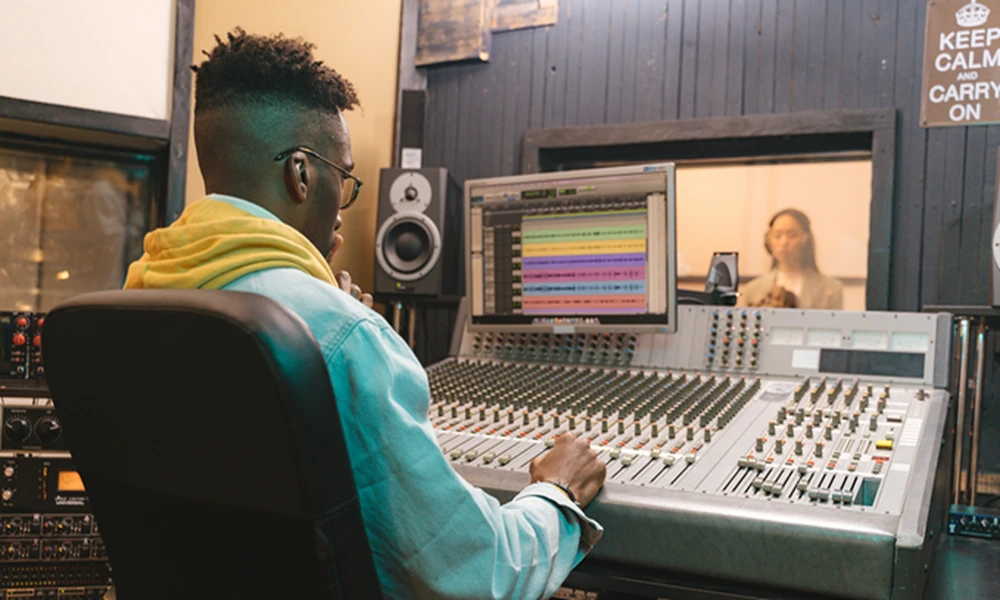

The line between amateur music production and a professional release has never been thinner in terms of access to tools. Today, anyone with a laptop can download the exact same plugins, software instruments, and digital audio workstations (DAWs) used by Grammy-winning engineers. Yet, despite having access to identical digital tools, a glaring gap often remains between a bedroom demo and a polished, commercial record.
The differentiator is rarely the gear; it is the workflow. Professional engineers operate with a distinct set of systematic habits that protect their ears, optimize their decisions, and prioritize translation across all playback systems.
If you want to elevate your tracks from amateur projects to professional masters, look closely at your mixing routine. Implementing these seven foundational habits will completely shift how you approach your music.
1. Mixing at Conservative Monitoring Volumes
Amateur producers love to turn the volume up. The human ear naturally perceives louder sounds as “better” due to the way our auditory system processes frequency response at high volumes (a phenomenon known as the Equal-Loudness Contours). However, mixing loudly tires out your ears within an hour, causes you to overcompensate with your low-end adjustments, and tricks you into thinking a flat mix sounds energetic.
Professionals do the exact opposite. They spend the vast majority of their mixing sessions at conversational volumes-around $75text{ dB}$ to $85text{ dB}$ SPL. If a mix sounds punchy, balanced, and emotionally engaging at a whisper-quiet level, it will sound absolutely massive when turned up on a club sound system.
2. Committing to Audio and Printing Tracks Early
In a modern DAW, it is tempting to keep every virtual instrument live, every MIDI note editable, and dozens of CPU-heavy plugins active until the final bounce. This infinite flexibility breeds decision paralysis. Amateurs tweak synth parameters and MIDI notes endlessly instead of focusing on the actual mix.
Professionals value commitment. Once they are happy with a synthesized sound or a programmed drum pattern, they bounce it down to raw audio. Working with static audio tracks forces you to treat the production as a finished canvas. It frees up valuable computer CPU, provides visual clarity on your timeline, and shifts your brain out of “composing mode” and firmly into “mixing mode.”
3. Relying on High-Quality Reference Tracks
An amateur mixer operates in a vacuum, focusing entirely on their own project file for hours on end. Without a reality check, your ears quickly adapt to the specific flaws of your room and your speakers, leading to a mix that sounds great in your studio but completely falls apart in the car.
Professional mixers continuously recalibrate their ears by using commercial reference tracks. By importing a professionally mixed and mastered song in a similar genre directly into their project, they can instantly compare the low-end weight, vocal clarity, and stereo width of their track against a proven standard.
4. Prioritizing Level Balancing and Panning First
It is a common amateur mistake to load up complex plugins-like multi-band compressors, dynamic EQs, and saturation tools-the moment a mix session opens. They try to fix poor arrangements or unbalanced tracks with heavy processing.
A professional engineer understands that up to 80% of a great mix comes down to two simple things: volume sliders and panning knobs. Before touching a single plugin, a pro will spend considerable time establishing a rock-solid “fader balance.” If a song doesn’t feel cohesive using only volume and stereo placement, no amount of advanced digital processing is going to save it.
5. Managing Low-Frequency Headroom Intersections
Amateurs frequently let every individual track retain its natural low-end energy. They assume that leaving sub-bass frequencies on an acoustic guitar or a vocal track adds “warmth.” In reality, this invisible low-end rumble eats up precious digital headroom, causing the master limiter to distort much earlier than it should.
Professionals treat the low-end like a premium piece of real estate. They use high-pass filters to systematically remove useless low frequencies from non-bass instruments. This clears an intentional path for the kick drum and the sub-bass to dominate the bottom end, resulting in a significantly louder, cleaner, and more impactful final product.
6. Checking the Mix Regularly in Mono
With modern software offering extreme stereo widening tools, amateurs often craft wide, immersive soundscapes that sound incredible on studio headphones. However, they forget that many real-world listening environments-like bars, restaurants, clubs, and mono Bluetooth speakers-sum the left and right audio channels together.
Professionals constantly check their work in mono. If a wide-panned synth or a vocal track relies on phase manipulation to sound wide, it will completely disappear when collapsed to a single channel. Mixing in mono highlights frequency masking and level imbalances immediately, allowing you to fix them before they ruin a consumer’s listening experience.
7. Taking Mandatory, Structured Ear Breaks
Ear fatigue is the ultimate enemy of a great mix. After prolonged listening, human ears lose their sensitivity to high frequencies, causing producers to gradually add more treble and harshness to their mixes as the session drags on. Amateurs often push through an eight-hour session straight, resulting in a mix they regret the next morning.
Professionals manage their physical energy strictly. They use the Pomodoro technique or set explicit timers to step away from the speakers every 45 to 60 minutes. Giving your ears ten minutes of absolute silence resets your auditory perspective, ensuring that your final mixing decisions are based on reality rather than exhaustion.
Transitioning from an amateur workflow to a professional one is a deliberate choice. It requires trading chaotic tinkering for structured, intentional habits. While these guidelines provide a foundational roadmap, mastering the finer nuances of acoustics, signal architecture, and advanced mixing theories often requires a dedicated educational environment. Immersing yourself in a comprehensive music program for producers can streamline this learning curve, providing the direct mentorship and technical structure needed to turn these standard habits into second nature. Until then, turn your monitors down, clean up your low-ends, and mix with intention.